Barbados Currency and Money: Dollars, Cards and Tax
The Barbados dollar is fixed at BBD 2 to USD 1. US dollars and major cards are widely accepted, buses need exact local cash, and standard VAT is 17.5%.
By Barbados 365 Editorial Reviewed by Alex Borshch, Founder & Editor
Published November 16, 2026 · 10 min read
Money in Barbados centres on the Barbados dollar, and the local currency has been fixed to the US dollar for half a century. Prices are shown in Barbados dollars (BBD, often written BDS$ or Bds$), US dollars are taken widely, and cards work in most hotels, shops and restaurants. The details that catch visitors out are smaller: the government bus requires the exact cash fare, taxis may want cash, and the tax on a bill depends on what you are buying.
This guide uses the Central Bank of Barbados, the Barbados Revenue Authority (BRA), the Barbados Transport Board, Visit Barbados and the UK Foreign, Commonwealth and Development Office (FCDO), as read in November 2026. Where we could not confirm a specific rule, we say so.
The short version
| Topic | What to know (as of November 2026) |
|---|---|
| Currency | Barbados dollar (BBD) |
| Rate with the US dollar | Fixed at USD 1.00 to BBD 2.00 since July 1975 (Central Bank) |
| US dollars | "Accepted island-wide" (Visit Barbados) |
| Cards | Most stores and restaurants accept major credit cards (Visit Barbados); taxis do not always (FCDO) |
| Government bus | BDS$3.50 per trip, exact fare, no change given |
| VAT | 17.5% standard; 7.5% on accommodating direct tourism services; 22% on telecoms |
| Car rental levy | BBD 5 per day, capped at BBD 35 per rental |
The Barbados dollar: notes and coins
The Central Bank of Barbados first issued the national currency in 1973. According to the Bank, banknotes come in six denominations: $2, $5, $10, $20, $50 and $100, and circulation coins in four: 5 cents, 10 cents, 25 cents and 1 dollar. The one-cent coin stopped being issued in 2014. All notes are the same size, so check the colour and number rather than reaching for the biggest one.
Small coins matter more than you might expect. The government bus takes exact fares only, and roadside snacks, a coconut water on the beach at Accra Beach or a fish cake from a stall are easiest with small local change.
The 2 to 1 peg with the US dollar
The Central Bank describes how, on 5 July 1975, the Barbados dollar was fixed to the US dollar "at a rate of USD1.00 to BBD2.00", and that rate still holds. In practice this means one US dollar is worth two Barbados dollars, so a BDS$40 dinner is US$20. The Bank also publishes buying and selling rates for the public each business day, which is why the figure on a bank's exchange board is close to, but not exactly, 2.
Visit Barbados, the official tourism site, gives the rate on its travel information page as US$1 = BDS$1.98. This tourism-page figure differs from the Central Bank's official 2 to 1 peg. Ask your bank for its current buying rate. When a shop takes US dollars, ask what rate it applies before you pay.
For UK visitors, there is no fixed rate with the pound. The sterling value of a Barbados dollar moves with the pound against the US dollar, so check the rate shortly before you travel.
Paying in US dollars
Visit Barbados says "US dollars are accepted island-wide". That makes US cash a reasonable backup for American and Canadian visitors in particular. Two practical points follow. First, you may receive change in Barbados dollars, so it helps to pay with smaller US notes. Second, the Transport Board states its fare in Barbados dollars and requires the exact amount in the farebox, so carry the exact local cash fare for it.
Pounds sterling and other currencies
We found no official statement that shops or restaurants accept pounds sterling, euros or Canadian dollars in cash, so do not plan on spending them directly. British visitors are better served by a card for larger purchases and Barbados dollars (from an ATM or a bank) for small ones. Our first-timer's guide has more on what to pack and plan.
Cards: where they work and where they do not
According to Visit Barbados, most stores and restaurants accept major credit cards, which covers most spending in resort areas such as Holetown and Hastings and Worthing; confirm with your hotel when you book. The FCDO's advice for taxis is the important exception: drivers do not always accept card payments, so carry cash. The same caution makes sense for small beach vendors, rum shops and food stalls.
When a card terminal or ATM offers to charge you in your home currency instead of Barbados dollars, choosing the local currency usually leaves the exchange rate with your own card issuer rather than the terminal operator. Check your bank's foreign transaction fees before you go.
ATMs and exchanging money
Bank branches are concentrated in Bridgetown and the larger coastal towns; if you want cash on landing at Grantley Adams International Airport, check the airport's own information before you fly. Visit Barbados says ATMs only dispense local currency, so expect Barbados dollars from a cash machine. Your own bank may charge a foreign withdrawal fee on top of any fee the local machine shows on screen.
To change cash, use a bank or an exchange counter and compare the rate with the 2 to 1 peg: a US dollar rate close to 2 is fair, and anything well below it is costly. For pounds or euros, compare the offered rate with the current market rate.
The FCDO's safety advice applies here too: take care when taking money from ATMs, and do not carry large amounts of cash. Our Barbados safety guide sets out the full advisory.
VAT and other charges on your bill
The Barbados Revenue Authority lists four VAT rates, as of November 2026:
- 17.5%, the rate for standard supplies, which covers most purchases;
- 7.5%, on accommodating direct tourism services;
- 22%, on telecommunications services (relevant if you buy a local SIM or data);
- 0%, on zero-rated items.
Check whether a menu or quote already includes VAT before you pay. The BRA's own example of a car rental quote shows how the pieces are itemised: a base price of $100.00, a Car Rental Levy of $5.00 (not subject to VAT), VAT at 17.5% on the base price of $17.50, and a total of $122.50.
That levy is new. Since 15 October 2025 the BRA charges a Car Rental Levy of BBD 5.00 per day on every vehicle rental, capped at BBD 35.00 per rental (seven days), and it applies per rental, not per driver. On the same date the Visitor Driving Permit was abolished: visitors must show a valid driving licence to the rental company and check any other rental requirements. Our getting around Barbados guide covers renting and driving on the left.
Service charge and tipping
As of November 2026, Visit Barbados says gratuities of 10 to 15 percent are automatically added to bills in many places. This describes a practice, rather than a compulsory extra tip. Read the bill before you add anything: if a service charge line is already there, an extra tip is your choice, not an obligation. If no service charge appears and you were well looked after, leaving something for the staff is appreciated, in cash where possible so it reaches the person who served you.
For taxis, the FCDO says taxis do not have meters, that there are standard fares for most destinations, and that you should agree the fare in Barbados dollars before you set off. Agreeing the fare first is the simplest way to avoid a dispute over change or tips at the end of the ride.
What things cost, in words
The only prices we quote are the ones set by official bodies. The Transport Board's fare is BDS$3.50 per trip, as of November 2026, with the exact fare required and no change or refund given, and the Board says it is rolling out a cashless fare system in phases. That makes the bus a low-cost option for journeys from Oistins to Speightstown.
Beyond that, expect a wide range. Eating at a fish fry such as the Oistins Fish Fry or from a local lunch spot costs far less than a sit-down restaurant on the west coast. A rum punch at a rum shop and the same drink at a beach-club bar can cost different amounts. Paid attractions such as Harrison's Cave, St Nicholas Abbey and boat trips like catamaran cruises set their own prices, so check the operator's site before you budget. Imported goods in supermarkets carry the cost of shipping to an island. Free pleasures are plentiful: most beaches, from Carlisle Bay to Mullins, cost nothing to visit.
Peak periods push accommodation prices up. Our best time to visit Barbados and Barbados in winter guides explain when demand is highest, and the 5-day itinerary shows a balanced mix of free and paid days.
A practical money checklist
- Tell your bank you are travelling and check its foreign transaction and ATM fees.
- Carry two cards from different networks in case one is declined.
- Get some Barbados dollars on arrival, including coins for the bus.
- US visitors: bring some small US notes as a backup.
- Agree every taxi fare in Barbados dollars before setting off.
- Check bills for VAT and any service charge before adding a tip.
- Keep valuables and spare cash in a hotel safe, as the FCDO advises.
Before you land, complete the Barbados immigration and customs form, and save the emergency contacts page. More practical notes are on our local tips page.
Frequently Asked Questions
What currency is used in Barbados?
The Barbados dollar (BBD). The Central Bank issues notes of $2, $5, $10, $20, $50 and $100, and coins of 5, 10 and 25 cents and 1 dollar. Prices are normally shown in Barbados dollars, so check which currency a price is in before you pay.
Is the Barbados dollar fixed to the US dollar?
Yes. The Central Bank of Barbados fixed the rate at USD 1.00 to BBD 2.00 on 5 July 1975, and that peg still holds. Banks quote buying and selling rates close to that figure, so the rate you get when exchanging cash can be a little under 2.
Can I use US dollars in Barbados?
Generally yes: Visit Barbados says US dollars are accepted island-wide. Expect change in Barbados dollars. For the government bus, carry the exact local cash fare: BDS$3.50 as of November 2026.
Can I pay with pounds sterling in Barbados?
We found no official source saying shops accept pounds in cash, so do not count on it. Use a card for larger payments and withdraw or exchange Barbados dollars for small purchases, taxis and buses.
Are credit cards accepted in Barbados?
Visit Barbados says most stores and restaurants accept major credit cards. The FCDO notes that taxi drivers do not always accept cards, so carry cash for taxis, small vendors and the bus.
What is the VAT rate in Barbados?
The Barbados Revenue Authority lists 17.5% for standard supplies, 7.5% on accommodating direct tourism services, 22% on telecommunications services and 0% on zero-rated items, as of November 2026.
Do you tip in Barbados?
As of November 2026, Visit Barbados says gratuities of 10 to 15 percent are added in many places. Check the bill first: if a service charge is already included, any extra is optional. If it is not, a cash tip for good service is appreciated. For taxis, agree the fare in Barbados dollars before setting off, as the FCDO advises.
Photo gallery
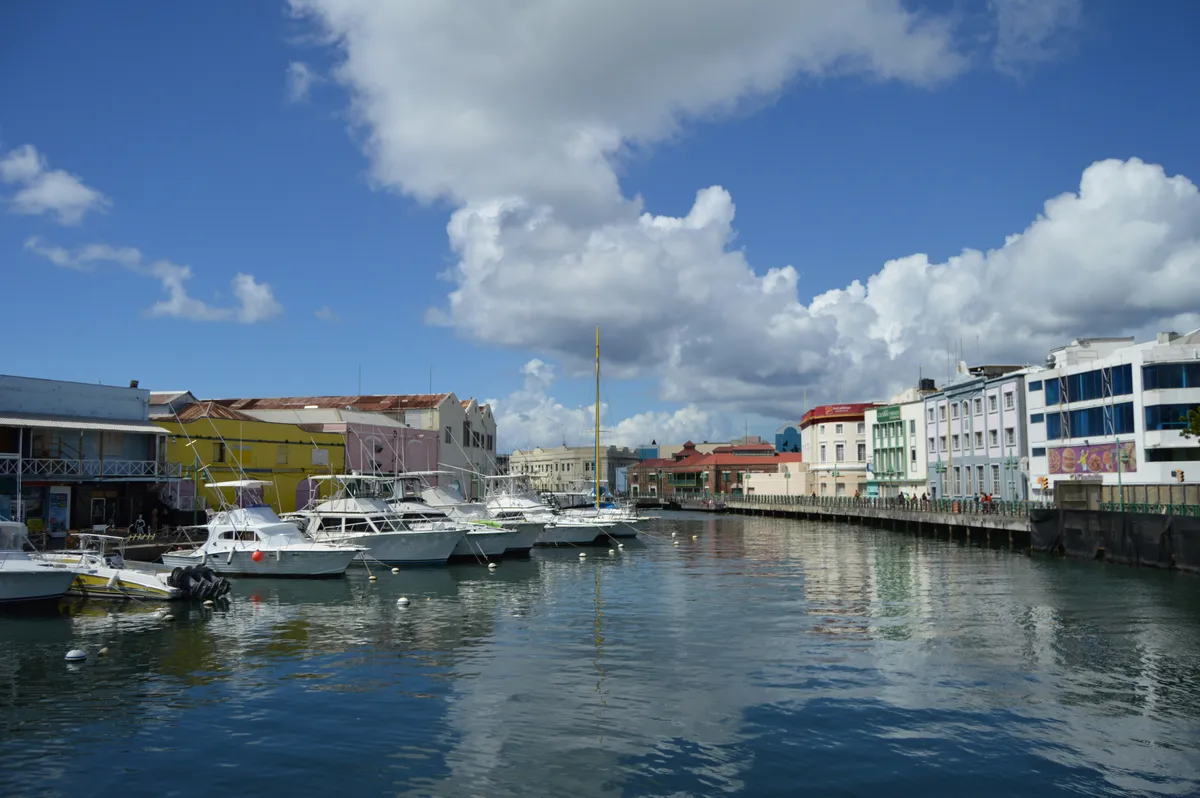
Boats moored along the Independence River waterfront in Bridgetown
Photo by Scott S. Bateman on Unsplash · Unsplash License