Is Barbados Safe? What the Official Advisories Say
The UK FCDO carries no advice against travel to Barbados and the US rates it Level 1. Both flag crime precautions, and the UK warns about strong currents, especially on the east coast.
By Barbados 365 Editorial Reviewed by Alex Borshch, Founder & Editor
Published November 16, 2026 · 10 min read
Most questions about safety in Barbados come down to three things: crime, the sea and the weather. This guide reports what the official travel advisories say, in their own terms and with their dates, rather than offering reassurance or alarm of our own. The main sources are the UK Foreign, Commonwealth and Development Office (FCDO) travel advice and the US State Department, plus Barbados government bodies where they speak to a point, all as read in November 2026.
What the official advisories say
| Source | Status | Date |
|---|---|---|
| UK FCDO | No advice against travel to any part of Barbados | Updated 23 January 2026; still current at 16 November 2026 |
| US State Department | Level 1, Exercise Normal Precautions | Issued 10 April 2026 |
UK. The FCDO's Barbados page carries no advice against travel. Its standard opening line applies here as everywhere: "No travel can be guaranteed safe." The January 2026 update removed information about flight disruptions. The FCDO advises travel insurance covering your itinerary, planned activities and expenses in an emergency.
US. The State Department advisory issued on 10 April 2026 places Barbados at Level 1, "Exercise Normal Precautions". It says petty crime is common, especially in popular tourist locations, and most crimes against foreigners are crimes of opportunity, such as purse snatching and pickpocketing. US travellers should read the advisory at travel.state.gov before booking.
Crime: the FCDO's wording
The FCDO says there have been incidents of violent crime in Barbados, including armed robbery, sexual assault, gang-related shootings and carjackings, and that there has been an increase in gang-related murders involving guns. It adds that some incidents have taken place in populated and public areas. It does not name specific districts.
The precautions it lists are these, in its words:
- make sure your accommodation is secure;
- take care when walking alone off busy main roads and taking money from ATMs;
- avoid isolated areas, including beaches, particularly after dark;
- only use licensed taxis;
- take particular care around large gatherings, including street and beach parties, especially after dark or during the festival season;
- do not carry large amounts of cash or wear expensive-looking jewellery;
- leave valuables and travel documents in a safety deposit box or secure hotel safe.
The festival point matters if you are visiting for Crop Over and Grand Kadooment, or for busy nights such as the Oistins Fish Fry and the bars of St Lawrence Gap. Our Crop Over guide covers planning for the festival period. On terrorism, the FCDO says there is no recent history of terrorism in Barbados but attacks cannot be ruled out.
Sea safety by coast
The FCDO's swimming advice is direct: "Always take great care when swimming." It then makes four points that apply all around the island:
- currents can be deceptively strong, including on some of the popular beaches on the south and west coasts;
- some beaches do not have lifeguards or warning flags;
- existing lifeguard stations are not staffed 24 hours a day;
- motorised water sports equipment, including jet skis, dive boats on snorkelling tours and catamarans, may operate near the shore.
East coast. The FCDO says swimming is not recommended on many of the east-coast beaches, where currents are particularly strong, and tells visitors to follow local warnings. This is the Atlantic side, around Bathsheba and the Scotland District, with beaches such as Bathsheba (the Soup Bowl), Cattlewash and Bath. Enjoy the views and the walks; enter the water only where local warnings and lifeguards allow.
South and south east. The FCDO's warning about deceptively strong currents explicitly includes popular south coast beaches. Apply this advice along the stretch from Accra (Rockley) Beach to Dover Beach and on round to the more exposed south east, including Crane Beach and Bottom Bay near The Crane. Read flags where they exist, and ask locally where they do not.
West coast. The Caribbean side is also named in the FCDO's current warning, and boats and jet skis can operate near the shore. Apply this advice at beaches such as Carlisle Bay, Paynes Bay and Mullins. If you join swimming with turtles or snorkelling trips, stay close to the operator's boat and briefing area.
Health
The FCDO lists Zika virus, dengue and chikungunya among the health risks in Barbados, all spread by mosquitoes, so pack repellent and protect yourself against mosquito bites. It says the healthcare system is less extensive than the UK's, that the Queen Elizabeth Hospital can cope with many types of treatment, and that serious cases may need medical evacuation. Medical treatment in Barbados can be expensive, and some private clinics may not accept travel insurance as payment, so check their prepayment policies.
On drinking water, Visit Barbados says the water supply, provided by the Barbados Water Authority, is safe to drink. The FCDO's ambulance advice is to dial 511.
Hurricanes and the weather
The FCDO says the hurricane season normally runs from June to November and advises monitoring local news and World Meteorological Organization weather reports for Barbados. If you travel in those months, check forecasts in the days before you fly, keep your airline's contact details to hand, and follow instructions from your hotel and the local authorities if a storm approaches. Our best time to visit Barbados guide covers the seasons, and the weather page has the climate overview.
Driving and taxis
Barbados drives on the left; Visit Barbados reminds visitors that speed limits vary and seatbelts are compulsory. Since 15 October 2025 visitors no longer need a Visitor Driving Permit: the Barbados Revenue Authority says visitors must hold a valid driving licence and present it to the rental company, which now charges a Car Rental Levy of BBD 5 per day, capped at BBD 35 per rental (as of November 2026). The FCDO refers drivers to its general driving abroad guidance.
For taxis, the FCDO says they do not have meters, that there are standard fares for most destinations, and that you should agree the fare in Barbados dollars before you set off. Use licensed taxis only. Our getting around Barbados guide covers buses, taxis and driving in more detail.
Laws visitors break by accident
- Camouflage. The FCDO says it is illegal for anyone, including children, to wear camouflage clothing. Leave camouflage-pattern clothes and accessories at home.
- Drugs. The FCDO says it is illegal to possess drugs and there are severe penalties for all drug offences.
- Other people's bags. Pack your luggage yourself and do not carry anything through customs for anyone else.
- Customs declarations. The FCDO says there are strict rules about goods brought into and out of Barbados; declare anything that may be prohibited or dutiable on the online immigration and customs form.
For LGBT+ travellers, the FCDO says attitudes in the Caribbean are mostly conservative, and that it is uncommon for opposite or same-sex couples to show affection in public, which may attract unwanted and negative attention.
Emergency numbers
| Service | Number |
|---|---|
| Police | 211 |
| Ambulance | 511 |
| Fire | 311 |
These three numbers appear on both the FCDO's Barbados page and Visit Barbados's medical services page, as of November 2026. For a British national in difficulty, the FCDO's 24-hour line in London is 020 7008 5000, for urgent help if something has happened to a friend or relative abroad. Keep our emergency contacts page saved on your phone.
Planning with the advice in mind
The advisories point to ordinary habits: secure accommodation, licensed taxis, valuables in a safe, care after dark and at big parties, and great care in the sea. Choose a base with our where to stay guide, read the first-timer's guide and the currency and money guide for handling cash, and check our local tips. Families can start from the 7-day family itinerary and apply the sea advice above to every beach day.
What we could not confirm
- Penalty amounts for wearing camouflage.
- Whether a particular beach has a lifeguard on duty at the time you visit. Check locally and follow flags.
- Live sea conditions at individual beaches.
Frequently Asked Questions
Is Barbados safe to visit in 2026?
The UK FCDO has no advice against travel to Barbados (updated 23 January 2026, still current on 16 November 2026), and the US State Department advisory issued on 10 April 2026 places Barbados at Level 1, Exercise Normal Precautions. The FCDO also reports incidents of violent crime and lists precautions, so follow them.
What level is the US travel advisory for Barbados?
The State Department advisory issued on 10 April 2026 places Barbados at Level 1, Exercise Normal Precautions. Check travel.state.gov for updates.
Is it safe to swim on the east coast of Barbados?
The FCDO says swimming is not recommended on many east-coast beaches, where currents are particularly strong, and to follow local warnings. It also warns that currents can be deceptively strong on some popular south and west coast beaches and that some beaches have no lifeguards or flags.
What precautions does the UK advise in Barbados?
Secure accommodation; care when walking alone off busy main roads and at ATMs; avoiding isolated areas, including beaches, after dark; licensed taxis only; care around large gatherings, especially at night or during festivals; no large amounts of cash or expensive-looking jewellery; and valuables in a safe.
Is it illegal to wear camouflage in Barbados?
Yes. The FCDO says it is illegal for anyone, including children, to wear camouflage clothing in Barbados. Do not pack it.
What are the emergency numbers in Barbados?
Police 211, ambulance 511 and fire 311, as listed by the FCDO and Visit Barbados in November 2026.
When is hurricane season in Barbados?
The FCDO says the hurricane season normally runs from June to November. Monitor local news and World Meteorological Organization weather reports if you travel then.
Photo gallery
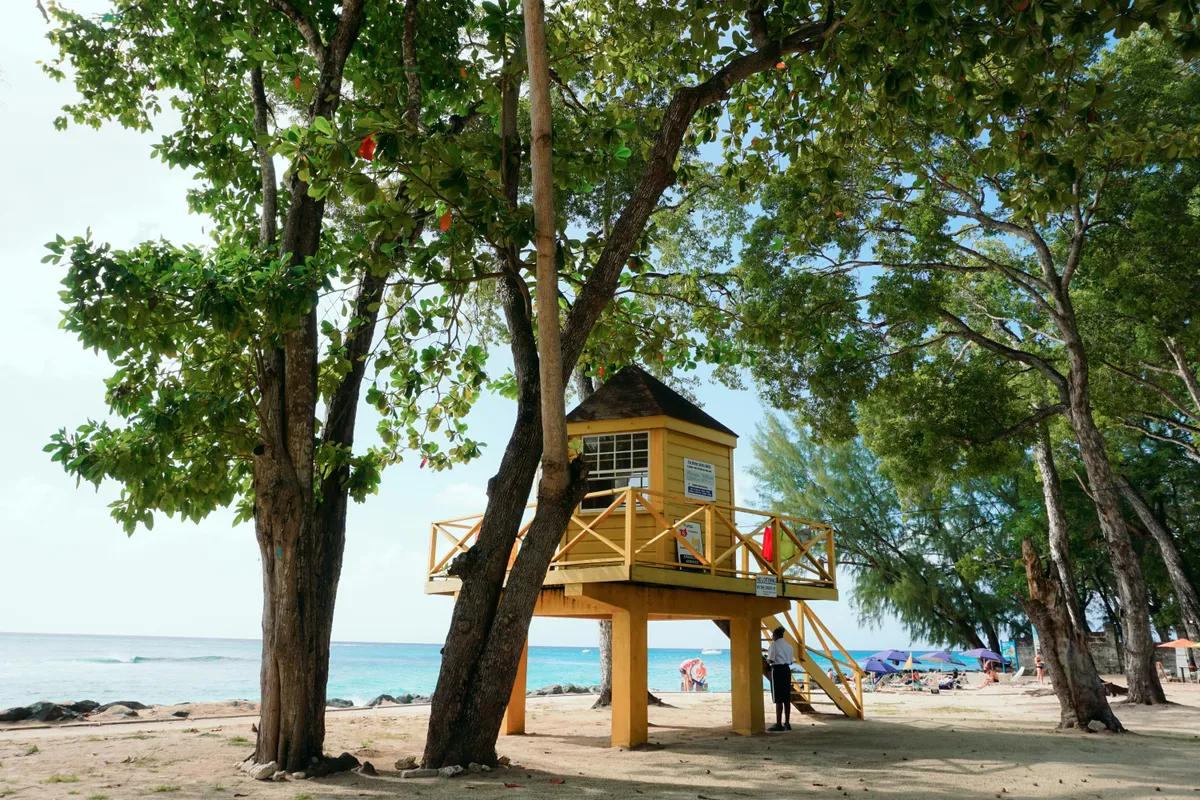
Yellow lifeguard hut among shade trees on a sandy Barbados beach
Photo by Chloe Christine on Unsplash · Unsplash License