Best Time to Visit Barbados: Month-by-Month Guide
The driest, sunniest months in Barbados are February to April; the wet season and the Atlantic hurricane season run from June to November, and Crop Over fills July and early August.
By Barbados 365 Editorial Reviewed by Alex Borshch, Founder & Editor
Published November 16, 2026 · 9 min read
The short version
Barbados is warm all year, so the question is less about heat and more about rain, crowds and what is on. The Barbados Meteorological Services (BMS) normals for 1991 to 2020 show average daily highs between about 29C and 31C (84F to 88F) in every month. What changes is the rain: March is the driest month on that record, with under 40mm, and October is the wettest, with close to 180mm.
For most visitors the choice comes down to three windows. December to May is the dry season. The winter months are a popular time for winter-sun travel. May and June are quieter, still mostly dry early on, and good value. June to November is the wet season and overlaps with the Atlantic hurricane season, but it also brings Crop Over, a major summer festival, and lower demand outside the festival weeks.
Barbados weather month by month
The table below uses the climate data sheet published by the Barbados Meteorological Services, whose office is in the Civil Aviation Department Building at Charnocks, Christ Church, near Grantley Adams International Airport. All figures are 1991 to 2020 averages. The sheet does not identify the observation station, so these figures should not be treated as measurements for every part of the island. Rain days are the average number of days with rain in the month.
| Month | Average high | Average low | Rainfall | Rain days | Sunshine a day |
|---|---|---|---|---|---|
| January | 29.1C (84F) | 23.3C (74F) | 68.1mm | 11 | 8.5 hours |
| February | 29.2C (85F) | 23.0C (73F) | 41.7mm | 9 | 8.8 hours |
| March | 29.7C (85F) | 23.4C (74F) | 38.9mm | 8 | 8.8 hours |
| April | 30.2C (86F) | 24.2C (76F) | 58.1mm | 8 | 8.7 hours |
| May | 30.6C (87F) | 25.0C (77F) | 74.1mm | 8 | 8.5 hours |
| June | 30.7C (87F) | 25.2C (77F) | 101.2mm | 11 | 7.5 hours |
| July | 30.7C (87F) | 25.1C (77F) | 121.5mm | 15 | 8.1 hours |
| August | 30.9C (88F) | 24.8C (77F) | 150.6mm | 16 | 8.4 hours |
| September | 31.0C (88F) | 24.8C (77F) | 162.6mm | 13 | 7.8 hours |
| October | 30.8C (87F) | 24.7C (76F) | 179.6mm | 15 | 7.7 hours |
| November | 30.3C (87F) | 24.5C (76F) | 172.6mm | 14 | 7.6 hours |
| December | 29.6C (85F) | 23.9C (75F) | 91.0mm | 11 | 8.2 hours |
Averages are a planning guide, not a forecast. Rain can affect plans in either season. Check the BMS forecast in the days before you fly.
Dry season and wet season
Visit Barbados, the official tourism site, describes two main seasons: a dry season during the northern hemisphere winter and spring, when temperatures are a little cooler and there is less rain, and a wet season during the northern hemisphere summer and autumn, when days tend to be warmer and rainfall is higher. The BMS normals bear this out. February, March and April each average under 60mm of rain and 9 or fewer rain days, while every month from July to November averages more than 120mm.
The north-east trade winds blow almost every day, which takes the edge off the heat. They also explain why the two sides of the island feel so different. The west coast around Holetown and Speightstown sits in the lee of the island and usually has calmer water, while the Atlantic side at Bathsheba takes the full force of the wind and swell.
Hurricane season
The US National Hurricane Center sets the official Atlantic hurricane season as 1 June to 30 November, and notes that storms sometimes form before or after those dates. It puts the statistical peak of the Atlantic season at 10 September, with most activity between mid-August and mid-October. The UK Foreign Office travel advice for Barbados says the hurricane season normally runs from June to November and tells travellers to monitor local news and the National Hurricane Center.
In practice, if you book between June and November, buy travel insurance that covers weather disruption, keep an eye on the forecast from the BMS and the National Hurricane Center in the week before you travel, and follow official instructions on the island if a storm warning is issued. The emergency contacts page lists the numbers to keep with you.
Sea temperature
Visit Barbados gives ocean temperatures of 26C to 29C (79F to 84F) all year round, so the sea is warm enough for swimming in every month. It is never cold, but the coasts differ in what the water does. The calm bays of the west and the Carlisle Bay area suit snorkelling and swimming with turtles most of the year. The UK Foreign Office warns that currents can be deceptively strong even on some popular south and west coast beaches, that some beaches have no lifeguards or warning flags, and that swimming is not recommended on many east coast beaches. Treat Bathsheba Beach and Cattlewash Beach as places to look at the sea, not to swim in it.
Crowds and prices through the year
Demand follows the northern winter. For a winter trip, compare flights and accommodation early, including west coast hotels around Paynes Bay and Mullins Beach. Check availability for Christmas, New Year and Easter before settling your dates.
May and June are worth comparing with winter dates if your budget is flexible. Check accommodation and festival dates together, especially if you want to stay near the nightlife of St Lawrence Gap and Hastings and Worthing. October and November have the highest average rainfall in the BMS table.
Month-by-month highlights
December to February
The dry season settles in, with highs around 29C and the highest daily sunshine averages in February and March. Independence Day on 30 November opens the season, and Christmas on the island is busy. January brings Barbados Sailing Week, which Visit Barbados lists for 15 to 21 January 2027. February is Holetown Festival month, marking the arrival of the first settlers at Holetown on 17 February 1627; the festival's own site gives 14 to 21 February 2027. If a home Test or one-day series is on, cricket at Kensington Oval is worth a day; check the fixture list before you book. For more detail see our guide to Barbados in winter.
March and April
March is the driest month on the BMS record, and April averages just 8 rain days. The Sandy Lane Gold Cup, run at the Garrison Savannah, is the highlight of horse racing at the Garrison; the 2026 race was on 7 March, and a confirmed 2027 date was not found in the official sources checked as of November 2026. The Oistins Fish Festival takes place every Easter weekend in Oistins; Easter falls on 28 March in 2027. Check school-holiday dates and accommodation availability if travelling at Easter.
May and June
Rain starts to climb, from 74mm in May to just over 100mm in June, and June has the fewest sunshine hours on the record at 7.5 a day. This is good value time for scuba diving, catamaran cruises and sightseeing inland at Harrison's Cave and St Nicholas Abbey. The hurricane season officially starts on 1 June.
July and August
Crop Over, which the National Cultural Foundation describes as a festival of about three months, builds to Kadooment Day, the first Monday in August, with the Grand Kadooment parade. In 2027 that is Monday 2 August. Emancipation Day is commemorated on 1 August; in 2027 its public holiday is observed on Tuesday 3 August under the Public Holidays Act. Expect higher demand and prices around those dates, and book well ahead if the festival is the reason for your trip. Read our Crop Over guide before you plan.
September to November
The wettest stretch of the year and the heart of the hurricane season. Check availability and the forecast rather than assuming quiet beaches or guaranteed sunshine. The Barbados Food and Rum Festival ran from 5 to 8 November in 2026, and Independence Day on 30 November closes the year's calendar of national days.
Which month suits you
For the best odds of dry, sunny beach days, choose February, March or April. For lower prices with mostly fair weather, look at May and early June. For culture and nightlife, aim for late July to early August and Crop Over. For surfing, ask a local surf school about the Atlantic swell at the Soup Bowl on the east coast and where to start if you are new to it. If you plan to travel in the hurricane season, keep your dates flexible and your insurance comprehensive.
Whenever you go, our first-timers guide, the 2027 public holidays list and the weather page will help you plan. To compare where to base yourself, see where to stay in Barbados, and for ideas once you arrive, things to do in Barbados.
Frequently Asked Questions
What is the best month to visit Barbados?
For weather alone, March is the driest month on the Barbados Meteorological Services 1991 to 2020 record, with 38.9mm of rain over about 8 rain days, and February and April are close behind. These are also peak months, so book early. May is a good compromise between weather and price.
When is hurricane season in Barbados?
The official Atlantic hurricane season runs from 1 June to 30 November, according to the US National Hurricane Center, which puts the peak of the season around 10 September. The UK Foreign Office advice for Barbados says the season normally runs from June to November.
What is the rainiest month in Barbados?
October, with an average of 179.6mm of rain on the BMS 1991 to 2020 normals, followed by November at 172.6mm and September at 162.6mm. Monthly averages do not predict conditions on an individual day.
How warm is the sea in Barbados?
Visit Barbados, the official tourism site, gives sea temperatures of 26C to 29C (79F to 84F) all year round. The water is warm enough for swimming in every month, but strong currents on many east coast beaches make them unsafe for swimming.
When is Crop Over?
Crop Over runs for about three months and builds to Kadooment Day, the first Monday in August, with the Grand Kadooment parade. In 2027 Kadooment Day is Monday 2 August. The National Cultural Foundation publishes the full schedule each year.
Is Barbados expensive in winter?
December to April is a popular winter-sun period. Compare flights and accommodation early for Christmas, New Year and Easter, and compare rates with May, June and September to November.
How hot does Barbados get?
Average daily highs range from 29.1C (84F) in January to 31.0C (88F) in September on the BMS normals. The BMS sheet, published in October 2023, lists an extreme of 34.2C on 30 September 2023. Nights stay mild, with average lows of 23C to 25C.
Photo gallery
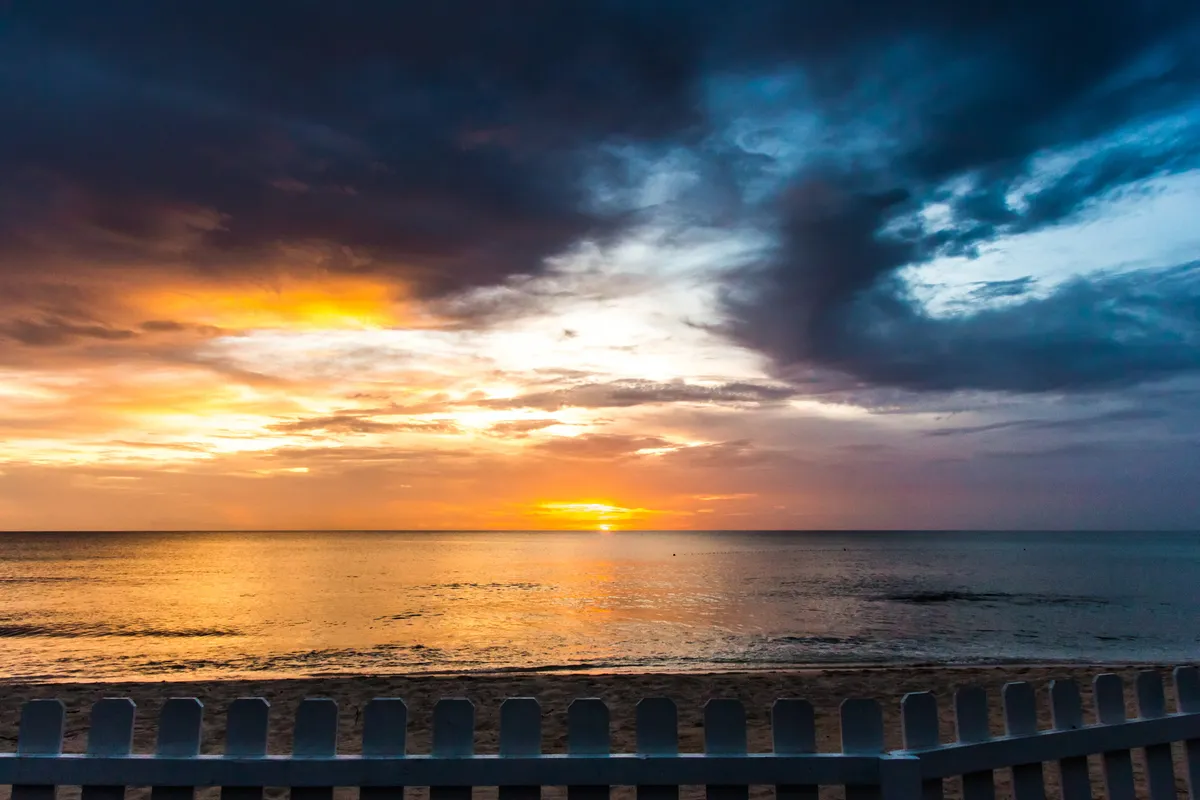
Sunset over the sea from a beach in Barbados
Photo: bez_uk via Wikimedia Commons · CC BY-SA 2.0 (https://creativecommons.org/licenses/by-sa/2.0)